
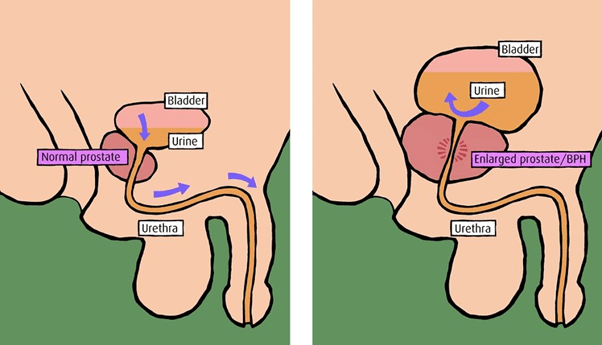
The Prostrate gland, which grows during early puberty and then again around age 25, becomes enlarged in many men. It can pinch your urethra, the tube that carries urine from your bladder through your penis. Your bladder walls may also grow thicker.
This is the most common prostrate problem in men 50 and older.
As they age, some men may notice that they have trouble peeing. You might find it hard to start going, or perhaps the stream starts and stops several times.
These are just two possible signs of benign prostratic hyperplasia, called BPH, which is an enlarged prostate.
Symptoms
The severity of symptoms in people who have prostate gland enlargement varies, but symptoms tend to gradually worsen over time. Common signs and symptoms of BPH include:
- Frequent or urgent need to urinate
- Increased frequency of urination at night (nocturia)
- Difficulty starting urination
- Weak urine stream or a stream that stops and starts
- Dribbling at the end of urination
- Inability to completely empty the bladder
- Pain during ejaculation
Less common signs and symptoms include:
- Urinary tract infection
- Inability to urinate
- Blood in the urine
The size of your prostate doesn’t necessarily determine the severity of your symptoms. Some men with only slightly enlarged prostates can have significant symptoms, while other men with very enlarged prostates can have only minor urinary symptoms.
In some men, symptoms eventually stabilize and might even improve over time.
Other possible causes of urinary symptoms
Conditions that can lead to symptoms similar to those caused by enlarged prostate include:
- Urinary tract infection
- Inflammation of the prostate (prostatitis)
- Narrowing of the urethra (urethral stricture)
- Scarring in the bladder neck as a result of previous surgery
- Bladder or kidney stones
- Problems with nerves that control the bladder
- Cancer of the prostate or bladder
When to see a doctor ?
What Should I Watch Out For?
Symptoms of BPH fall into 2 categories. Those caused by pressure on your urethra are called obstructive. The others start in your bladder.
Some of the obstructive symptoms include:
- Trouble starting to urinate
- You have to strain or push when you pee
- The stream is weak
- You have to stop and restart several times
- Pee dribbles out at the end
If BPH causes changes in your bladder, it may include these signs:
- You suddenly feel a strong need to urinate. Doctors call this “urgency.”
- You have to pee more than 8 times a day. This is called “frequency.”
- Even after you go, you feel as though your bladder is not empty.
- You wake up often in the night to relieve yourself. This is called “Nocturia.”
Complications
If you don’t get treatment for Prostrate problems, your bladder can become irritated because urine is backing up rather than being released.
Your symptoms may start to cause more issues in your day-to-day life. For instance, it may be tough for you to control your bladder. You might wet the bed at night or not be able to get to the bathroom quickly enough when the urgent need to go strikes.
You also could develop an infection in your urinary tract or get bladder stones.
Some symptoms of BPH are not as common, and they could signal that your condition is more complicated or advanced. Those signs include:
- Burning or pain when you pee
- Blood in the urine.
- You can’t go at all because your urethra is blocked. Get emergency treatment right away if this happens.
If you’re having urinary problems, discuss them with your doctor. Even if you don’t find urinary symptoms bothersome, it’s important to identify or rule out any underlying causes. Untreated, urinary problems might lead to obstruction of the urinary tract.
Homoeopathic medicines are proved on human beings unlike conventional medicines which are researched on animals, It not only studies the physical, pathological changes but also has a vast clinical research data of the mind and behavioural changes for many medicines.
Widely used and indicated homoeopathy medicines for benign prostatic hyperplasia includes
- Pulsatilla nigricans – It is an indicating medicine when patient suffering from pain and tenesmus urinating. Urine passed in drops and stream is interrupted. Patient also feels pain from abdomen to testicles with thick yellow discharge from the urethra. Pain becomes worse by lying on back. In addition, involuntary micturition at night, while coughing indicates use of Pulsatilla nigricans to manage the symptoms of prostate enlargement.
- Digitalis purpurea – It is an indicated in cases where lower urinary tract symptoms are associated with heart symptoms. Patient have continuous urging and urine comes in drops. There is sharp cutting or throbbing pain at the neck of bladder. Pain feels as if a straw was being thrust back and forth. In addition, irregular heart beat, frequent stitches in heart may also present in the patient.
- Conium maculatum – Conium maculatum acts upon glands and alter the structures like scrofulous and cancerous conditions. There is much difficulty in voiding of urine. Urine flows and stops again. In fact, Conium maculatum is an useful medicine in dribbling of urine in old people.
- Triticum repens – It is an excellent medicine for excessive irritability of the bladder with frequent, difficult, and painful urination. Prostate is enlarged and dense urine causes irritation of the mucus surfaces. Bacterial infection (pyelitis) and irritation of base of bladder with severe pain and strong desire to urinate indicates use of medicine to manage the symptoms of benign prostatic hyperplasia.
- Populus tremuloides – It is useful medicine in old people for enlarged prostate with presence of urinary and gastric symptoms. Patient feels pain at the end of urination and urine contains mucus and pus. Gastric symptoms includes indigestion with flatulence and acidity.
- Baryta Carb: Baryta Carb is known to effectively treat the problem of dribbling after urination in benign prostate hyperplasia cases. Another indication for using Baryta Carb in BPH is sudden urge to urinate, with the inability to retain urine. The urine may be scanty. Burning while passing urine may also be observed.
- Clematis Erecta– When there is Difficulty in Initiating Urine
Clematis Erecta is indicated when there is difficulty in starting to urinate due to prostate enlargement. The person needs to strain hard before urine starts to flow. Intense burning may arise while passing the last drops of urine. Dribbling after urination may also be present in some cases
Chimaphila Umbellata: When there is Difficulty in Initiating Urine.
Chimaphila Umbellata is just as helpful where a person needs to strain hard to start passing urine. Urine is scanty and may also be offensive. Burning or scalding while passing urine may also be present. In extreme cases, the urine is passed with a lot of strain, with the body inclined forwards.
Thuja Occidentalis – For Urgency to Urinate
In case of marked urgency to urinate in benign prostate hyperplasia, Thuja Occidentalis is the most appropriate prescription. The urine stream is small. Frequent urge to pass urine may be present. Burning or cutting pain while urinating may be observed. Thuja Occidentalis also effectively treats involuntary urination at night.
Agnus Castus – For Sexual Complaints in BPH
Agnus Castus is a very well indicated medicine for treating sexual complaints in men from benign prostate hyperplasia. Agnus Castus can treat weak erections or complete loss of erections from prostate enlargement. Loss of sex drive in men who suffer BPH can also be treated well with Agnus Castus.
- Sabal serrulata – It is indicated medicine for irritability of the genito-urinary symptoms. There is discharge of prostatic fluid with enlargement of gland. In addition, patient suffers from difficult urination with burning of urethra indicates use of Sabal serrulata in benign prostatic hyperplasia.
- Ferrum picricum – It works well in conditions where patient suffering from smarting at neck of bladder and penis with senile hypertrophy of the prostate. Patient feels pain along entire urethra and frequent micturition at night with pressure in rectum. In addition, retention of urine indicates that Ferrum picricum may helps to relief the symptoms prostate enlargement.
- Lycopodium clavatum– Lycopodium clavatum wonderfully acts in cases where patient suffers from pain in back before urinating and urination ceases after flow. Patient urinates higher amounts of urine during night with heavy red sediment in the urine. In fact, it is useful medicine to provide relief for the patient from symptoms of benign prostatic hyperplasia.
Calcarea Carb, Apis mellifica, Causticum,Thuja, Sulphur, Staphysagria and many more homoeopathy medicines may also used to treat benign prostatic hyperplasia with their own peculiar indications.
Note: All the given medicines are indicative. Self prescription is harmful. Consult your homoeopathic doctor for detailed case taking for holistic treatment.
 The Art Of Healing